

By: Diane Nicole Go, GIA Graduate Gemologist
Whether you’re buying a gift, ready to propose to the love of your life, or even just buying for yourself online, finding the right size of jewelry can be difficult, especially if you can’t try out the piece yourself. We make things easier for you by giving you a clear picture on how to find the right size here.
Choosing the right ring size is important—a ring that’s too tight is uncomfortable or impossible to wear, while a ring that’s too big will easily slip off and get lost. Ring sizes are based on the numerical scale, with the inner circumference of the band as basis. This is measured in millimeters, with increments of 2-3mm as the size goes up.
Choosing the right ring size is important—a ring that’s too tight is uncomfortable or impossible to wear, while a ring that’s too big will easily slip off and get lost. Ring sizes are based on the numerical scale, with the inner circumference of the band as basis. This is measured in millimeters, with increments of 2-3mm as the size goes up.
| Measurements | Ring Conversion Table | |||||
|---|---|---|---|---|---|---|
| Milimeters | US | British | British | German | Swiss | Japanese |
| 46.0 | 4.0 | H | 47 | 15 | 7 | 7 |
| 47.6 | 4.5 | I | 48 | 15.5 | 9 | 8 |
| 49.2 | 5.0 | J | 50 | 15.8 | 10 | 9 |
| 50.8 | 5.5 | K | 52 | 16 | 12 | 10 |
| 52.4 | 6.0 | L | 53 | 16.5 | 13 | 12 |
| 53.2 | 6.5 | M | 54 | 17 | 14 | 13 |
| 54.8 | 7.0 | N | 55 | 17.3 | 15 | 14 |
| 56.4 | 7.5 | O | 56 | 17.8 | 16.5 | 15 |
| 58.0 | 8.0 | P | 57 | 18 | 18 | 16 |
| 57.8 | 8.5 | Q | 58 | 18.5 | 19 | 17 |
| 58.7 | 9.0 | R | 59 | 19 | 20 | 18 |
| 60.3 | 9.5 | S | 60 | 19.5 | 21.5 | 19 |
| 61.9 | 10.0 | T | 61 | 20.3 | 22 | 20 |
| 63.5 | 10.5 | U | 62 | 20.8 | 23.5 | 22 |
| 65.1 | 11.0 | W | 63 | 21 | 25 | 23 |
| 65.9 | 11.5 | X | 64 | 21.3 | 26 | 24 |
| 66.7 | 12.0 | Y | 66 | 21.8 | 27.5 | 25 |
There are things to consider in choosing the right size, some of which include:
Now there are two ways to go about this: You want to figure out the size of your finger, or you have a ring and you want to figure out its size. Jewelers and jewelry shops have tools that can help you out there.

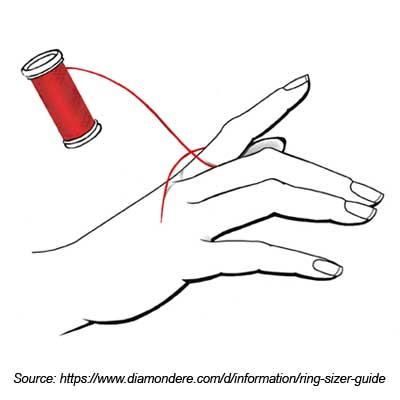
If you somehow cannot get a hold of a ring sizer, you can also wrap a ribbon or string around your finger, mark the point where the ends meet, then measure it with a millimeter ruler. Go with the closest measurement in the chart to find your ring size.

The right kind of necklace can really accentuate your look. Necklaces are the first things people often notice about you, and the right length and style will really make you stand out. When it comes to choosing what necklace best fits you, you need to consider your height, body type and face shape.
Your height also plays an important part in choosing a necklace. Longer necklaces can overwhelm people with a smaller frame but look better on taller women. And remember: people’s eyes will stop right where your necklace ends—usually at the pendant. If you have a small bust, a long thin chain or layered pieces would suit you. On the other hand, if you’re full-figured, necklaces that go below the chest area are not recommended, since it may not hang properly. You’re better off with an 18 to 22-inch necklace.
Face shapes are also important in considering what necklace suits you. If your face is round, short necklaces and chokers emphasize the roundness of your face, so avoid that. Oval-shaped faces are lucky, as any style suits them. Those with longer faces are better off with shorter necklaces because they help soften your features and keep it from adding length. Heart-shaped faces, on the other hand, can wear chokers because it balances a narrow chin.
Before buying a necklace, it’s very important to measure your neck, especially if you plan on getting a choker. Take a tape measure and wrap it around your neck. Add 2 inches for allowance, so that it sits comfortably when you move around. People with long necks are suitable for chokers, while those with shorter necks are better off with necklaces 16 inches and above.

14 inches: Fits like a choker and wraps closely around your neck.
16 inches: Reaches the base of the neck, like a collar. If you’re petite, it will hit the collarbone, while for plus size women, it will feel like a choker. It’s good for everyday necklaces, as they don’t get caught on things.
18 inches: The common go-to for women, this length allows for a small pendant. It falls just below the throat, right at the collarbone.
20 inches: Falls past the collarbone and allows for more breathing room. Wear it with clothes that have a plunging neckline or over a turtleneck.
22 inches: Falls at or above a low neckline. Also suitable with clothes that have a plunging neckline or over a turtleneck.You can wear this necklace with a pendant or as a station necklace, a style that features alternating gemstones on a chain.
24 inches: Falls below the neckline, above chest level. Wear it with a medium-sized pendant, such as religious items or statement pieces.
30 inches: Settles right below the chest. Station necklaces or a string of small pearls usually come at this length. Wear this chain with large statement pendants to stand out.
36 inches: This length hangs below the bosom, close to the stomach area. You can wear it as a single strand or loop them around and wear it as a double 18-inch necklace. It’s common with pearl strands or station necklaces.
When it comes to choosing the right necklace that suits you, it’s important to consider based on what flatters you—not just what’s trendy. Like all other jewelry pieces, necklaces reflect your style, so wear It with confidence!
Buying bracelets is much easier than rings, just as long as you know your wrist size. The ideal size sits comfortably on your wrist, between your hand and wrist bone. Standard size for women is 7 to 7.5 inches.
In order to get your bracelet size, use a tape measure. Measure it tightly at the broadest part of the wrist, just below the wrist bone. That gives you your wrist size. Now add around ¼ inch to 1 inch to get your bracelet size. The more allowance you add, the lower your bracelet goes, so be careful! Remember: the inner circumference is what you’re after, so use something flat to measure. Don’t use other bracelets or chains as basis, since the beads and stones get in the way, and you won’t get a very accurate measurement.


And there you have it! A simple guide on how to get the right size for your jewelry. Hope this helps you find the right gift for your loved ones, or even get that perfect piece of jewelry for yourself!